Tuesday, September 15, 2009
Hotness of Australian Guys
By Ceejay60.
I had to google to see who Keith Urban is. :P Oh yeah, that guy! The one who for some reason looks like Tim Minchin without makeup and shorter hair! (I don't know why I make that connection)
Like all (most? Debate it!) places in the world, there are certainly quite a few hot guys around the place. :P However, most are 'average' looking. But in a good way.
It's weird, but I *have* noticed a slightly different facial structure/attitude/expression on Australian faces vs 'foreign' faces (like the British or Americans). I can often pick out Americans from a group without ever hearing their voice. I can also pick out people from Polish ancestry. Apparently our mixes of races mixed in a different way, and our expressions are somehow different too!
Australia is not a place of hot people, just like any other country, with the possible exception of Sweden. :P (Kidding...) It's an ordinary place.
Has anyone else been able to 'pick' Australians (or other nationalities that are supposed to be from similar stock, such as Americans) from a crowd without hearing them speak?
Have you been to Australia and found a disproportionate percentage of the opposite sex 'hot'?
Saturday, September 12, 2009
Niagara Massage Chairs
It was a fantastic day, except for one nasty experience with a sales man at the display from Niagara chairs. He was incredibly rude and intimidating, and it is yet another example of discrimination against young people. Here is the letter I sent to the company a few minutes ago. I find it bizarre as all other displays in the whole exhibition always encourage interaction with the products, and most, even if you're a teenager unless you're being disruptive or it might hurt you.
Why are massage chair people the rudest people at the Adelaide Show? I met so many fantastic people there yesterday. Thanks to the Chutney guy, the Kyneton lamington woman, the nail art lady, the wobbly exercise machine woman, and soooo many more.
Note: This may just have been this one guy, not the whole company, but I've experienced rudeness in a similar vein before.
My boyfriend and I attended the Royal Adelaide Show on Sunday the 13th of September and experienced some rudeness by your staff in your stall. We are young looking, but we are 22 and 24 years old. I realise that there is often a 'no under 18s on the massage chairs' policy at the Royal Adelaide Show.
My boyfriend had been talking about getting a massage chair, and my Dad had been talking about getting one, so when we saw them we thought we'd go in to have a look.
We were immediately greeted by a man (I wish I'd got his name) in a very rude fashion, asking us what we were doing in his stall, as if we had no right to be there. My boyfriend, nervous at times, mumbled something about 'just interested in looking at your chairs'.
Your sales person then bluntly said that 'They're $9,000. How many do *you* want?'. My boyfriend thought he was joking on the last point, and said he'd take three. The salesman then demanded to see my boyfriend's credit card. He then told us that these chairs are only for 'old people', and that we couldn't use them, and that he only wanted to talk to 'old people', who would be coming in soon.
We left without looking at any chairs.
This whole exchange took less than a minute, and we were made very unwelcome.
We understand that teenagers often want to go in and 'try' the chairs with no intention of buying one. We also cannot afford a $9,000 chair right now, but we did not know how much they cost until we were 'informed' of this. This assumption that we were teenagers, or without money, and the rude manner that we were dealt with, means that we will be sure to not buy your products in future, even if we did have $9,000 to spend on a chair, and I will not be recommending Niagara chairs to my father.
I believe that this is very bad practice, and though I have been asked if I'm over 18 before at massage chair stalls, this goes far beyond that in terms of rudeness and assumptions.
I would suggest that your representatives be trained to try different techniques as to how to deal with potential 'time wasters'.
Thankfully the exercise equipment people (Whose products cost over $2,000) took me seriously and I now have their contact details to share with my parents who
were looking for options. They seemed to have no trouble accepting us as potential customers or influencers of parents and 'hype' to the general community.
I hope to receive a response soon.
My boyfriend also wrote them an email.
I went to see the display at the royal adelaide show yesterday. My experiences were quite offputting. I was immediately swooped upon and my purpose for being there was challenged. I am a younger person, so perhaps not the usual sales target. However, at 22, and my friend, 24, it's certainly not unreasonable that we could be genuine customers, or even just to be treated with respect and given some information about how they work.
It happens that I actually am interested in buying a massage chair, or a massage cover that slips over a chair. I didn't know the price range of the chairs, or if you sell the cheaper slip over ones, and, I still don't know this, for reasons that will become clear. So, after having my intentions challenged, I was then aburptly told that the chairs are $9000, with a sarcastic and hostile question "how many would *you* like to buy?". Now, the salesperson is probably correct. I can't afford that much. However, clearly I could not have known this previously, and therefore his rude attitude is entirely inappropriate. It should also not be ignored that there are 22 year olds who can afford such an amount.
So, assuming that he's not just being a jerk, I tried to make light of his comment by stating that I'll take 3, in a joking way. Perhaps he can give me a quick description of its mechanics, health benefits, suggest something more affordable, or politely apologise that they only cater to that particular price range with a thankyou for my interest in their product? However this was met with the demand that I show him my credit card, followed by a remark that these chairs are meant for elderly people, with a very pronounced implication that I am not welcome. At this point I was very confused and felt no other option but to move on, confused as to why I had such hostility directed at me, and having learnt nothing of the product except that they (all chairs? some chairs? most expensive? cheapest?) cost $9000, the salespeople are rude, and that I must be at least 25 in order to buy one.
There are certainly situations where a younger person could be disrupting enough to warrant this kind of rudeness. However, in this case I did nothing more than walk into this display area before this was directed at me. I was left with a sour feeling and certainly the affirmation that I will avoid this company, and, although I will have rare opportunity, I will discourage anyone from buying from this company given the topic arises.
I'm giving this feedback only because I don't think that it's right at all that a person should be treated in such a way merely because they don't fit the targeted market. I also understand that a salesperson can have a bad day, as can anyone. However, there are certainly ways of dealing with a bad day, and that certainly does not include taking it out on an unlikely customer.
Another point of view. I discussed this on a forum, and one of the responses was:
From what I've read, it sounds like he was definitely rude but I also think it's understandable. Though, understandable and excusable are two different things.
[...]
To be honest, though, I do think you both look like teenagers. Or at least could pass as teens. I'd completely understand how someone would peg you off as another teenager who isn't serious about buying a chair and only wants to try them.
Considering that, also remember that your presence there may not have just seen by the salesperson as a waste of his time but as a discouraging presence among a target group. Remember that these rules of marketing were not simply created by the people who sell such products but by the consumers, themselves. Rich people don't want to shop where poor people shop, stuff like that. The salesperson may have wanted you out of there in case more serious shoppers wouldn't want to approach the vendor with you there.
Thursday, September 10, 2009
Arguments against the arguments (for not having national health care in the US)
These cons are *possibilities* not likelihoods, and some of them are remote possibilities. Furthermore, there are existing government services that contradict some of the posited cons.
*1*There isn't a single government agency or division that runs efficiently; do we really want an organization that developed the U.S. Tax Code handling something as complex as health care?
--- Talk about choosing examples of convenience... Your government also runs your military. Apparently the US military system has been deemed to be well run/effective/efficient by the repulicans (and even other nations.) Who's to say that healthcare would "look" more like the failings of the tax system, rather than the successes of the military system?
*2*"Free" health care isn't really free since we must pay for it with taxes; expenses for health care would have to be paid for with higher taxes or spending cuts in other areas such as defense, education, etc.
---- Nothing in life is ever free. Who said this healthcare would be free? The healthcare would be paid for by the users. Overall costs are reduced when "wholesale" prices can be negotiated. These prices can only be negotiated if there a significant number of users making use of a single system. Some users might find they have more services available at a lower cost in a public optioned system (if there are a large enough number of users to create leverage to reduce overall costs of services.)
*3*Profit motives, competition, and individual ingenuity have always led to greater cost control and effectiveness.
------- Erm... It appears the opposite is true in the current American healthcare system. On average, American healthcare costs are nearly double that of Canadians, who are currently under a public system. In fact, the very reason why system reform has become an issue is because healthcare costs have contravened the traditional trajectory of free market systems. As such, it appears that somehow, somewhere, the structure of healthcare in America is fundamentally flawed, or run from an economic system that is not capitalist at its root.
*4*Government-controlled health care would lead to a decrease in patient flexibility.
--- Patients are already complaining of a lack of flexibility with the current system. As such, this con is complaining about a problem that already exists, and would not be new. A system with increased number of contributors would actually *generate* flexibility when care options can be purchased wholesale... reduced costs overall for basic treatments means that even expensive treatments that are relatively rare *could* be covered.
*5*Patients aren't likely to curb their drug costs and doctor visits if health care is free; thus, total costs will be several times what they are now.
--- This con is referring to "frivolous use of services." While it is true that there may be a flood of "new" patients in the initial months/years, this is simply due to those individuals who will be seeking treatment for existing conditions/checkups because they could not do so before. This initial flood will wane after time, and a normal "flow" of patients will settle. Generally patients under a public system make no more or no fewer visits than patients who are insured. Another point to consider is that patients may actually have *fewer* visits if we consider healthcare over the lifespan... preventative care early in life generally leads to LESS dependence on healthcare services later on since minor conditions/or risky behaviours are LESS LIKELY to develop into long term chronic conditions.
*6*Just because Americans are uninsured doesn't mean they can't receive health care; nonprofits and government-run hospitals provide services to those who don't have insurance, and it is illegal to refuse emergency medical service because of a lack of insurance.
--- apparently 46 million americans are unable to obtain insurance. Lack of insurance means that americans cannot take preventative measures to maintain their health. lack of prevention explodes into chronic illness. if one is admitted to emergency due to illness, their condition has reached a life threatening stage, and they may die from what may have been preventable. furthermore, emergency services don't provide follow-up care, or respond to chronic conditions that only require medical maintenance (as opposed to treatment.) Can charities bear the burden of care for 46 million americans? a better question: *Should* charities bear the burn of care for 46 million americans?
*7*Government-mandated procedures will likely reduce doctor flexibility and lead to poor patient care.
--- Possibly, however this isn't the case in all the other developed nations who enjoy their universal access to healthcare. Certainly, there are complaints about poor services, just as there are complaints about poor services in any other industry where humans interact. Also, doctor flexibility may be increased, since they will be able to provide treatment to patients without having to consider which components of a treatment, or which treatments, a patient can afford. Essentially, a doctor's prudence, and patient choices of treatment options, will dictate care; rather than the amount of money a patient has in their bank account.
*8*Healthy people who take care of themselves will have to pay for the burden of those who smoke, are obese, etc.
---- Certainly. And those who don't mountain climb, or ride bikes will have to pay for the costs of those who incur injury as a result of their hobbies. Also, those who are hurt in heavy industry jobs will "cost" those who have less risky desk jobs. So what's the issue?
*9*A long, painful transition will have to take place involving lost insurance industry jobs, business closures, and new patient record creation.
---- certainly some jobs will be lost, however other jobs will be created, as is the natural flux of job creation in capitalist systems. is this "con" suggesting that the current (failing) system should be immune to the freemarket economy... somehow by "staying afloat" even when it is clear the services offered/affordability are failing its customers? and in any place where there is change, transitions are expected to be relatively difficult, simply because what is being done is "new." Are we suggesting, in this con, that America, the land of innovation, abstain from "transition" simply because it might lead to personal discomfort? Wasn't americal "built" on personal discomfort of a sort?
*10* Loss of private practice options and possible reduced pay may dissuade many would-be doctors from pursuing the profession.
------ All fields/industries have a natural "cap" to wages. (One can only work so many hours at a day, and the free market determines the cost of labour/service, hence there is generally an upper limit to earnings.) These wage caps, which are bread by the capitalist system, are generally a consideration for those interested in professional careers. There are other job options, if one is interested in earning more, less, or the same wages. We live under a capitalist system where people are free to choose whatever job they like, based on the considerations that are most meaningful to them.
*11*Malpractice lawsuit costs, which are already sky-high, could further explode since universal care may expose the government to legal liability, and the possibility to sue someone with deep pockets usually invites more lawsuits.
---- All of this con is conjecture, of course. Would there be more or less legal liability under a system where access to care and barriers to care are reduced? This is an important question to consider. Also, the government, under public systems, is generally a "payor" where the hospitals/clinics/doctors are private providers of service who are compensated by the payor. How is the government responsible for services that are provided by a hospital? Wouldn't it be the hospital's duty to take measures to reduce liablity claims... like having highly trained staff, or writing in non-liability in it's "care" contracts with patients (as insurance cos do at present, and as is being suggested by the GOP)? (All patients have to legally consent to a treatment, and the non-liability could be an aspect of consent, unless the medical notion of "duty of care" is contravened.)
*12*Government is more likely to pass additional restrictions or increase taxes on smoking, fast food, etc., leading to a further loss of personal freedoms.
---- having to pay more for a product does not reduce freedom in ANY manner, it simply means that a product costs more. Losing limbs or livelihood due to lack of access to care, however, may have serious consequences on the notion of "personal freedoms." Furthermore, with obesity on the increase, should the cost of nutritious food remain higher, calorie for calorie, than the cost of less nutritious food (as is the present case)? By reducing the cost of nutritious food, and increasing the cost of non-nutritious food, would we be creating "incentive" for people to make better food choices? And where diet is an enormous factor in preventing chronic illnesses like diabetes, heart disease, and some cancers, wouldn't it be somewhat *prudent* to make it more expensive (thus prohibitive) to consume poor-quality food?
*13*Patient confidentiality is likely to be compromised since centralized health information will likely be maintained by the government.
---- I don't understand how centralized health information =/= compromised confidentiality. The goverment will do as well on this issue as it does with other areas where confidentiality is expected, such as social security numbers, taxes, information collected as a part of military service.
*14*Health care equipment, drugs, and services may end up being rationed by the government. In other words, politics, lifestyle of patients, and philosophical differences of those in power, could determine who gets what.
--- At present health care is rationed to those who are able to pay. The "rationing" those who cannot afford to pay is: nothing. As such, rationing, technically, already exists. At present, politics, philosophical differences of those in power currently DO guide distribution of services; the present politics and philosophies dictate that those who are able to pay are those who should have access to services. It also dictates that those who are unable to pay need beg, borrow, or sell their material goods to afford healthcare. It also dictates that in the absence of charity or worldly goods to sell for healthcare, a person is undeserving of healthcare, unless they are dying in an emergency ward. The present system also considers the lifestyle of patients in the distribution of healthcare... those seeking insurance need fill out extensive questionaires to determine the costs and services provided under their insurance. Smokers, the obese, those with "risky" lifestyles generally pay more in insurance fees than others. Under public systems, generally each pays into the payor system based only on one factor: their income (through taxation).
*15*Patients may be subjected to extremely long waits for treatment.
---- Treatment is based on triage. Those in the most life threatening circumstances are treated first. Is there a problem with waiting for an elective procedure, such as a skin tab removal, or knee laroscopy, when a person may die if they are not treated before you are? Also, most treatments have a window where they are most beneficial... for example one can't wait too long to get a cast on a broken limb, otherwise the bones will continue to reknit, resulting in deformity, or a need to "rebreak" the bone. and one can't wait for treatment for cancer. Treatments under public systems are provided in their "beneficial window," just as they are provided under private care. Generally these windows are outlined in Medical Association approved treatment practices, which are practices that are endorsed and applied under currently existing public systems.
*16*Like social security, any government benefit eventually is taken as a "right" by the public, meaning that it's politically near impossible to remove or curtail it later on when costs get out of control.
------ Most nations with public systems understand that their access to healthcare is not a "right" in the formal sense. Moreover, public access to healthcare is considered a *privilege* of living in a developed nation. Why is America, a developed nation that prides itself on innovation and its ability to transcend virtually all oppressions, denying its citizens of a privilege that every other developed nation is currently enjoying? Is America oppressing its citizens by denying them a public healthcare option? Has America become a nation for the rich, instead of a nation for all people? These are important questions to consider.
Tuesday, September 8, 2009
Vegemite
Hi! I'm an Australian with a similar problem. As a child, I hated vegemite! I was a travesty to the Australian traditional childhood! ... or not.
Honestly, I didn't like it because I didn't try to eat it often enough. It is most certainly an acquired taste, and it really has to be eaten in extreme moderation. It is STRONG.
It is usually the children who were fed it as small children who enjoy it, not the adults who try it for the first time.
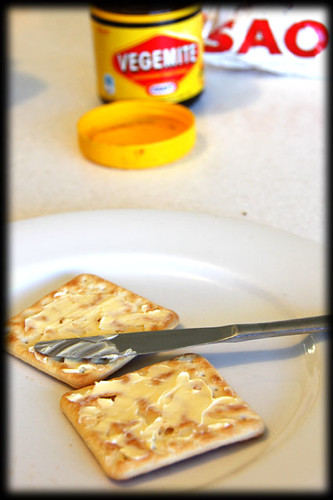
That said, another option is on dry biscuits with butter (and I mean the teeniest, tiniest, thinnest layer of vegemite). By dry biscuits I mean 'Sao' biscuits.
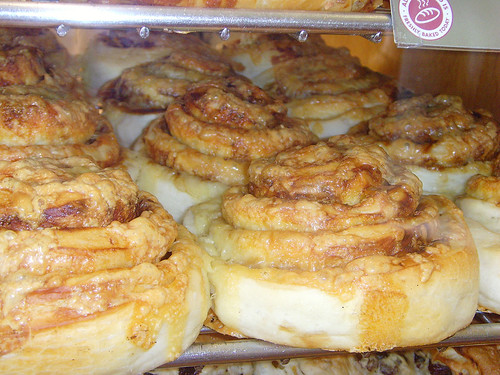
But it's actually a quite nice ingredient in various savoury recipes! If you can get a hold of 'cheesymite scrolls' try it. That's the only way I eat vegemite. It's a savoury bread scroll, with cheese and a tiny bit of vegemite within it, rolled up. You eat it cold, and I buy it from a bakery chain here called Baker's Delight. Or you could make some yourself.
You can also use it in various meals! I direct you to the official vegemite website since I assume they know what they're talking about, and have pretty pictures to show examples.
Enjoy giving it another go!
The Great Barrier Reef

Q: What is the status of the Great Reef Barrier from your (local) close perspective over there? (akapalaria )
I'm not quite sure how to answer this question. The status as an icon is that... well it's not a South Australian icon, and most South Australians have never been. I've been... once. When I was 4. I still have absolutely fantastic memories- of small glass bottomed boats and clear waters and beautiful corals, and gorgeous beaches along the coast. One morning my mother and I woke up and went down to the beach at dawn, and the whole beach was covered with tiny blue butterflies. Other beaches were covered in almost microscopic crabs. Our caravan parks were right on edge of the rainforest, and we played on the vines like they were swings. We patted sting rays in a giant touch pool, and found giant shells on the beach. The glimpses of the actual reef that we saw through the glass bottomed boat were stunning, though none of our photos turned out properly pre digital age and photographing through glass.
I'd highly recommend it as a tourist destination- as long as this tourism is careful and responsible, and not damaging to the local environment.
It's environmental status... to be honest, it is endangered. Temperature changes and pollution have damaged the coral, which are living beings. In many areas its colour is fading to white, bleached by damage. Extra nutrients in the water from sewerage etc has caused too many water weeds to grow, which suck life out of the balance. The reef also has a status as being one of the most fantastic natural features on the globe. What others do you know of?
Monday, September 7, 2009
School Question About Australia
She asks: What months do children go to school there?? Is it Aug/Sept to June like the US?
No, Iheartmetees, it's not. The reason for this is that our seasons are opposite to yours! June is the middle of our winter, and we don't get snow (in cities, where most of our population is). Our Summer is at Christmas time, so the summer/christmas holidays are combined. The children get a six or seven week holiday over Christmas/Summer, starting around the 11th of December and ending at the end of January.
The school year is divided up into four terms (two semesters), unless you live in Tasmania, where they kept the old three terms a year format (and I believe they get longer holidays). Each term is about 10 weeks long, some are shorter or longer depending on quite arbitary seeming things, and there is a two week break in between each of them.
Something that I consider good or interesting about this system (not that you can help it with your crazy backwards seasons :P ) is that it is the same calendar year for their whole school year. 2009, they ARE in year 3. Or whatever.
It's hard for me to wrap my head around only having a short holiday for Christmas!
Thursday, July 2, 2009
Puppy Boy
Thursday, May 21, 2009
A Useful Link
I'm using this right now to work out payments for our website's products. It's very tricky!
Monday, May 18, 2009
Controversy
Saturday, May 16, 2009
20 Ways Ordinary People Can Change The World Via The Internet
I was thinking the other day that ordinary people can do so much to change the world without even getting off their computer. So I wrote a list of ways.

1. Create a website that you think needs to be made, or help on someone else’s website.
2. Use websites such as freerice.org and raise money for charity while you play or view. Use bookcrossing.com and share the joy of seeing a book travel around the world. Search for other websites like that. Basically, have interesting and useful fun online.
3. Buy online from people who hand craft items if you can’t shop locally- support local/independent workers rather than corporations or factory machines. Etsy is good for this, but there are others. You’re paying for ethically made items, and for artisan made (often custom made!) items that take hours. You’re getting a bargain. Similarly, buy second hand online, or swap.
4. Link to great sites where you can. You’ll change the owner’s world, and if they really are great, you'll change the life of whoever now has a chance of seeing the link.
5. Comment on or talk about things that are important to you. There’s a lot of chatter on the internet, but the chatter could represent you and your opinions. One drop of water raises the sea. Don’t leave everything to other people and assume someone else will say it, if it really matters.
6. Protest.
7. If you like something you read on a website or a forum, tell them. Compliments can make people happy. There’s real people on the other end of the ‘series of tubes’ that make up the internet. People seem to only take the time to complain.
8. Make someone’s day.
9. Share your CPU cycles to cure diseases, study global warming or explore space. You’re not using your computer all the time, you might as well be part of a super computer system doing research.
10. Give advice. The internet is full of people needing help and advice or a shoulder to lean on temporarily. Or mentor someone.
11. Age does not matter on the internet- use that to your advantage.
12. Reach out to a friend or family member. So, it’s better to call or visit. But where that’s not possible, taking two minutes to send a message online is a very good alternative.
13. Write something profound- a blog entry, article, fanfiction, forum post, it doesn’t matter.
14. Interact with other cultures or thoughts or types of people. Both sides will learn something.
15. Add to the positivity in the world.
16. Find new friends, and then meet in real life with them if possible.
17. Use the internet to find ‘real life’ causes to help.
18. Study. You’ve got a wealth of information at your fingertips.
19. Research or learn better ways of living. If you change, the world changes slightly.
20. Think of other ways to add to this list, then do them.
Digg This List
Image from Flickr.
Friday, May 15, 2009
Website Launches
There are two ways we could attempt it.
1) Put it up quietly, and let it grow slowly... and gamble on if it gets members.
2) Hype it up first, launch it with a lot of fanfare and gamble on if it'll come crashing down after 2 weeks if people get bored with it.
My natural reaction is 'put it up slowly! That way we don't have to deal with hundreds of new members all at once and we can ease into it! It'll develop a nice little community atmosphere, and it can slowly gain momentum. Also any prizes we give won't be useless! If we did it 'big' then after a few months, an offer of free whatevery won't be that much of a good deal, and it'd be weird to suddenly give free stuff out two months in, if we made a big fuss of it at the start yet no one really started joining!'
But there REALLY are some flaws to that. That's how we tried to start our positive news site.
No launch party or anything, we just put it up one day, and then started using it ourselves. I spent time over the next few weeks going around posting links to it on forums, other websites etc, telling friends about it, putting up Project Wonderful ads... I still hope for the best, but even now we can't get people to submit anything to us. I've got Twitter now, and I'm rssing the articles. Still. Some websites do start off like that okay. We just need(ed) two or three regular posters and it could have been awesome. But somehow, it hasn't hit it off with the Internet yet.
Internet, meet Not Negative News.
Oh sorry, the party music is too loud? I'll tell you about it later.
I'm not giving up at all, but wow maybe I should bribe five people somehow to start talking on it.
I'm considering doing things for our Messages site such as handing out vouchers, rewarding people for getting other people signed up, having competitions, linking in as many places as possible all at once instead of gradually... (any other ideas?) but I'm concerned that could backfire as well. If it doesn't hit it off straight away, because they'll look at it and go 'oh. It's not very active is it?' then forget about it and go on their way, (but it'd only not be active because it'd be new) then I'll have run out of places to advertise- forums won't want me to advertise again a few months later.
A big launch flop could be more detrimental...
Thoughts?
Adelaide Zoo Orangutan
No one can deny that this Adelaide, South Australia, orangutan is smart. She managed to deliberately short circuit an electric fence with a stick, and was building a mound out of grass and sticks in the ditch in order to get to the second electric fence.
She has been previously known (I saw it) to get into electrified areas of her enclosure (they were being protected to let plants grow) by a complex plan of jumping from trees and down support wires.
This recent escape attempt resulted in the evacuation of the Zoo on Mother's Day.
Ah, I love the Adelaide Zoo!
"This animal has a history of trying to outsmart and be a little bit smarter, and she's an animal which has caused lots of keepers a lot of late hours," he said.
Thursday, May 14, 2009
Your Favourite Charities
Small charities are fine. We'd prefer something that we can pay through paypal, and that is a 'good cause' (though I know that is subjective, we want it to be a non disputable good cause for the first charity at least).
I was thinking of a charity I've heard of where every 5 pounds pays for three books, and these books go to impoverished areas of the world in their local language.
Or World Vision- perhaps we could buy chickens or seeds (or goats or whatever, depending on how much we raise) for a family in Africa.
What would be your nominations? Or thoughts on things we should consider? (things that might put people off, for example)
Birthday
Why can't someone invent a way to have a virtual party... holograms or something!
Saturday, May 9, 2009
Promoting Your Blog or Cause
Our new website is slowly (though I'm sure my friend doesn't feel like it's slow, he's working very hard!) being developed, and it's now my job to trawl around through the internet looking for content for part of our website.
Part of our website will involve a different blog entry every day (or maybe even more than once a day once it really gets started!).
We hope to get an incredibly large range of topics covered, and from a very large variety of people. I'm hopeful that it could be a great social experience, as everyone can comment. When you're looking around for blogs you tend to look for ones that are similar to yourself... this one will allow a snippet of life to show from many different life viewpoints. Those who submit the articles will get a wider demographic looking at their writing, and those who are reading will get something new to read every day. Exciting stuff!
When the site is up we'll have a submissions form so that you can put it up yourself, but for the first few weeks, I'm going to be asking, and putting articles up under my own account (credited and linked to the original blogs of course) just to keep things moving along.
So, I'm asking you- Would you like some free blog promotion? Or to speak to the world about a certain topic?
If so, you can reply with a link to a certain blog post you think would be good, or just a link to your blog and let me pick out one or two of your articles to add to my list of submissions. Either way I'd credit you with a link back to your blog, unless you want to remain anonymous (tell me.)
Remember that the blog entry must make sense out of context! And for now, not be too 'topical' as it could take months for the website to be up properly.
What do you think of this idea?
$7.01
It is slightly depressing. That's the extent of money that our advertising has earnt us so far, and it certainly wasn't from this blog. It was from Fluffy Bricks.
However we've still not worked out Project Wonderful ads for Not Negative News.
How pathetic do I feel now?
It's sort of why I've not been posting on the blog very often. Just looking at it was depressing, and posting seemed futile.
However I've reactivated the ads on this blog and hopefully I'll be able to muster up some new posts and views, so we can keep plodding along. At this rate it'll take a million years, however I guess we're adding new websites at a consistent rate, and every little bit will help. And one or two might 'make it big'.
Colours
Help us out!
Friday, April 3, 2009
New Website
Thursday, April 2, 2009
Not Negative News
We now have Discussions, and capabilities to 'follow' threads and comments.
We've also had some thoughts about new ways to set the site out.
Sunday, March 8, 2009
At least, Not Negative News is. It gives rss of all news stories posted to N3 , which means it's an easy way to keep up.
I recommend it to anyone who has a website or blog- people will be interested in what you have to say, trust me.